International registers frequently represent the Europe incompletely: missing broadcast data, incomplete crew information, inconsistent title designations. CineCockpit connects relevant sources from the Europe directly, provider-neutral and interchangeable, and each use enriches the data record of a project further. Every claim comes with its source, collection date, and confidence interval.
Data delivers the finding. People deliver the judgment.
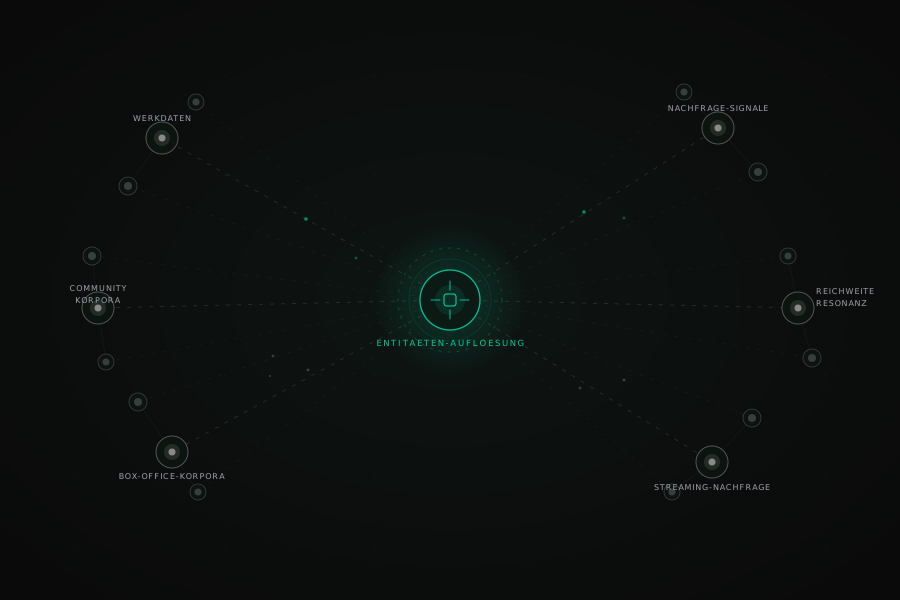
01 // SOURCE ARCHITECTURE
The platform connects a range of interfaces: social platforms, industry databases, public registers, and community corpora. All adapters are named by functional category rather than vendor name, and can be replaced or supplemented individually without changing the analysis logic.
International sources are only incorporated where DACH data is unavailable, for example in international comparable contexts during adaptation projects. They are always marked explicitly as INT / CONTEXT and do not carry the same evidential weight as DACH primary data.
Structured production and broadcast data from publicly accessible film and TV registers in the Europe. Foundation for competitive and catalogue comparison during story and concept development.
Publicly maintained filmographies and crew profiles from the German-speaking industry network. Adapter in development.
Aggregated reader ratings and sentiment time series from German-language community platforms. GDPR-compliant, no personal raw data.
Book market data: sales time series, bestseller lists, rights trade signals. Ingested as structured snapshot time series.
Linking of work and person entities via open, royalty-free knowledge graphs. Increased consistency when cross-referencing between sources.
Used only as supplementary context material, always explicitly flagged as such. Not treated on equal evidential footing with DACH primary data.
02 // DATA CATEGORIES
CineCockpit labels data sources internally by functional category rather than vendor brand name. This keeps the architecture extensible: one adapter can be replaced or supplemented without destabilising the analysis logic. For story development and screenplay analysis this means new sources can be integrated without unsettling existing findings.
Title, format, runtime, broadcast dates, production year, funding body. The foundation for all work records and comparables in the system. Each project is enriched against these registers on first match.
Consistent linking of works, people, and organisations via royalty-free knowledge graphs. Prevents duplicates and inconsistent spelling. A project's data record becomes more precise with each reconciliation pass.
Aggregated, anonymised search trend time series for projects, genres, and individuals. Measurable, dated, no personal data. Relevant for concept and format decisions in the early development phase.
Aggregated engagement and reach metrics from public platforms. Aggregates only, no individual profiles, no personal raw data. The adapter is interchangeable when platform APIs change.
Publicly available ranking data and demand indicators from the streaming market. Treated as context signal, no direct platform data access. Helps position projects within a competitive landscape.
Aggregated sentiment data from German-language literature and film community platforms. GDPR-compliant, no personal raw data. Each run adds a new dated entry to the sentiment time series of the relevant project.
CATEGORY: CRIME / THRILLER (SELECTION)
CATEGORY: DRAMA / SOCIAL
CATEGORY: HISTORICAL / BIOPIC
CATEGORY: ENTERTAINMENT / OTHER
03 // TAXONOMY
No sprawling catch-all drama bucket. CineCockpit classifies using industry-specific granularity that reflects the distinctions of the Europe: regional character, dialect region, funding context, and broadcaster grid. This categorisation is the basis for screenplay and story analyses where comparables need to be precise.
The taxonomy is editorially curated, not an algorithmic classification. New tags are reviewed and cannot be added unilaterally by users, preventing inconsistency in the corpus.
Example: "Alpine Noir" vs. "Small-Town Crime"
Both are crime, but with entirely different broadcaster networks, funding regions, casting profiles, and target audiences.
04 // COLLECTION PRINCIPLES
We do not extrapolate on assumption. Analyses are based on verifiably recorded releases and production lists from the Europe since 2010. If a data point cannot be cleanly substantiated, it does not appear as fact.
Instead of a continuous automated scraper, which is prone to errors and creates legal grey areas, CineCockpit uses carefully controlled collection snapshots with a defined reference date. The flywheel principle applies here: each use delivers a new dated snapshot that enriches the project's data record.
Every metric and market statement is delivered with primary source, exact collection timestamp, and calculated confidence interval. Ambiguous or outdated data is actively flagged as such.
CineCockpit does not output aggregated composite scores or traffic-light ratings. Instead, each relevant dimension (sentiment, demand signals, catalogue presence, and so on) is delivered as an individual value with its percentile rank in Europe context. Data delivers the finding. People deliver the judgment.
05 // LOCAL AI + DATA SOVEREIGNTY
CineCockpit runs exclusively on infrastructure within the EU. The AI models used are interchangeable and can be operated locally. No project, no concept document, no query leaves EU infrastructure without explicit authorisation.
This architecture protects the intellectual property value of early development stages: projects in raw concept form, unpublished source material, internal comparables. Data sovereignty remains with the organisation using the platform.
All data and models on EU servers. GDPR by design, no transfer to third countries without a data processing agreement.
AI models are not hard-wired. Switching to newer or locally operated models is possible without data migration.
Each analysis enriches the project's data record. The system becomes more precise with every run, without external data transfer.
Each production company operates in an isolated environment. No data leakage between clients, no shared model states.
06 // DATA PROTECTION IN COLLECTION
CineCockpit does not collect individual social media data from specific users. Sentiment data comes from aggregated, publicly accessible corpora and is processed exclusively in aggregated form.
Aggregated review scores, public book market data, catalogue title lists, publicly maintained industry data.
Individual social posts, private user profiles, location data, personal communications.
Each new source is reviewed for legal usability and GDPR compliance before activation.
In a demo we show you how provenance information appears at every data point and how you can trace the origin of any finding.
Request a demo